

Piping designers and piping engineers work on the same piping system, but they approach it from different directions. The piping designer develops the physical arrangement of the system, while the piping engineer establishes and verifies the technical requirements that make the system safe and suitable for its intended service.
In simple terms, a piping engineer determines what the piping system must withstand and which engineering rules it must satisfy. A piping designer determines how that system can be routed, supported, constructed, operated and maintained within the available plant space.
This distinction is useful, but it should not be treated as a rigid boundary. Responsibilities vary among engineering, procurement and construction (EPC) companies, plant owners and project sizes. Senior piping designers frequently make decisions requiring strong engineering awareness, while piping engineers need practical knowledge of plant layout and construction. Successful projects depend on both roles working together throughout the design cycle.
Quick answer: A piping designer concentrates on equipment layout, pipe routing, accessibility, constructability, 3D modelling and drawing production. A piping engineer concentrates on design conditions, codes, materials, calculations, specifications, system integrity and technical compliance.
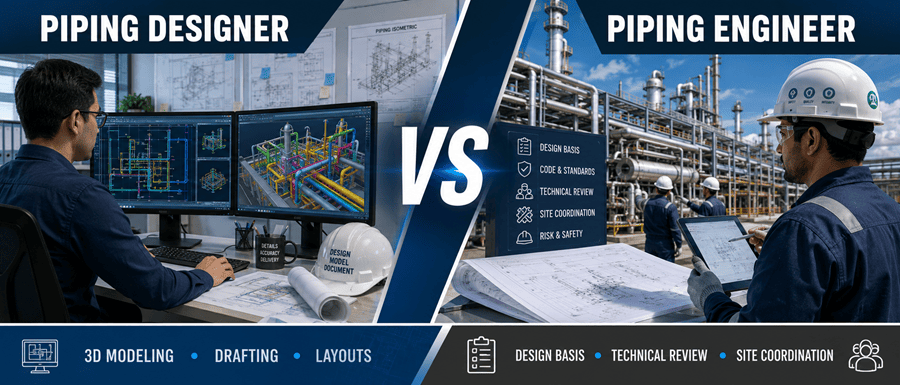
Piping Designer vs Piping Engineer: Quick Comparison
| Comparison Area | Piping Designer | Piping Engineer |
|---|---|---|
| Primary focus | Physical layout and detailed design | Engineering integrity and technical compliance |
| Main question | How can the piping be arranged safely and practically? | What must the piping withstand and which requirements apply? |
| Typical inputs | P&IDs, line list, piping classes, equipment data, plot plan and vendor drawings | Process data, design conditions, fluid service, client specifications and applicable codes |
| Core activities | Equipment layout, pipe routing, valve arrangement, support positioning and multidisciplinary coordination | Material selection, wall-thickness calculations, specifications, code interpretation and technical review |
| Main deliverables | 3D model, piping GA drawings, isometrics, nozzle-orientation drawings and support sketches | Design basis, piping material specifications, calculations, datasheets and technical requisitions |
| Common software | AutoCAD Plant 3D, AVEVA E3D/PDMS, Smart 3D, CADWorx and Navisworks | CAESAR II, AutoPIPE, calculation tools, spreadsheets and material databases |
| Key success measure | The system fits, functions spatially and can be built, operated and maintained | The system is safe, mechanically suitable and compliant with governing requirements |
Who Is a Piping Designer?
A piping designer converts process and engineering information into the physical layout of a piping system. The designer decides where equipment and piping should be located, how lines should travel between equipment nozzles and how the arrangement will interact with structures, platforms, cable trays, ducts, instruments and other plant systems.
Pipe routing is not simply a matter of connecting two points by the shortest path. The designer must account for safety, thermal expansion, drainage, access, maintenance, fabrication and construction. A route can look correct in a 3D model and still fail in the field if a valve cannot be operated, a flange cannot be unbolted, a pump cannot be removed or a support cannot be attached to the structure.
Modern plant-design software supports this work by connecting model information with production documents. For example, Autodesk describes AutoCAD Plant 3D as a toolset for developing P&IDs and 3D plant models and extracting orthographic and isometric drawings. However, software automates information and drawing production; it does not replace piping judgement.
Major Responsibilities of a Piping Designer
A piping designer commonly performs the following activities:
- Study P&IDs, line lists, piping material specifications and project design criteria.
- Review plot plans, equipment layouts and vendor drawings.
- Confirm equipment nozzle sizes, ratings, elevations and orientations.
- Develop equipment arrangements with adequate operating and maintenance space.
- Route process, utility, offsite, underground and interconnecting piping.
- Position valves, strainers, steam traps, instruments, vents, drains and specialty items.
- Apply slope requirements and avoid unwanted high points, low points and pockets.
- Provide access for valve operation, instrument reading and routine inspection.
- Protect walkways, escape routes, platforms and equipment-removal areas.
- Locate preliminary pipe supports and coordinate them with stress and structural teams.
- Participate in model reviews and resolve clashes with other disciplines.
- Prepare piping general-arrangement drawings, isometrics and support details.
- Verify line numbers, piping classes, component connectivity and material reports.
- Incorporate comments from stress analysis, vendors, clients, construction teams and site surveys.
Typical Deliverables Prepared by a Piping Designer
- Equipment layout and piping studies
- Three-dimensional piping and equipment models
- Piping general-arrangement drawings
- Piping isometric drawings
- Nozzle-orientation drawings
- Underground piping layouts
- Pipe-support location plans
- Special-support sketches
- Tie-in and battery-limit details
- Material take-offs and model reports
- As-built model and drawing updates
What Makes a Competent Piping Designer?
A competent piping designer combines spatial thinking with plant knowledge. The designer understands how pipes are fabricated, erected, supported, insulated, operated and maintained. This experience helps identify practical problems that may not be obvious on a computer screen.
For example, placing an isolation valve close to equipment may reduce pipe length, but the handwheel could be inaccessible. Raising the valve may improve operation but interfere with a platform or produce an unacceptable load on the connected nozzle. The designer must compare these constraints and develop a balanced solution.
Who Is a Piping Engineer?
- A piping engineer is responsible for the technical basis and mechanical integrity of the piping system.
- The engineer interprets process conditions and project requirements and converts them into suitable materials, component ratings, wall thicknesses, specifications, flexibility criteria, inspection requirements and engineering controls.
- The applicable code depends on the type of facility and service. ASME B31.3, for example, addresses process piping and includes requirements covering design, materials, fabrication, testing and inspection.
- Power piping, liquid pipelines and gas-transmission systems may be governed by other sections of the ASME B31 series or by different statutory requirements.
- The piping engineer must identify the correct requirements for the actual project rather than applying one code universally.
A code normally establishes minimum requirements. It does not remove the need for engineering judgement, client specifications, regulatory compliance or consideration of abnormal operating cases.
Major Responsibilities of a Piping Engineer
A piping engineer may be responsible for:
- Preparing the piping design basis, engineering criteria and discipline philosophy.
- Identifying applicable codes, statutory rules and client standards.
- Reviewing design pressure, design temperature, operating cases and fluid service.
- Selecting appropriate piping materials and corrosion allowances.
- Developing piping material classes and component specifications.
- Calculating or verifying pipe-wall thickness and pressure ratings.
- Checking branch connections and reinforcement requirements.
- Specifying valves, specialty items, insulation and related technical requirements.
- Defining critical-line and flexibility-analysis criteria.
- Reviewing piping-stress results, movements, support loads and equipment-nozzle loads.
- Preparing material requisitions and conducting technical bid evaluations.
- Reviewing vendor documents for technical compliance.
- Resolving material, fabrication, welding, testing and site technical queries.
- Assessing substitutions, deviations and non-conformities.
- Confirming that the final design satisfies project and code requirements.
Typical Deliverables Prepared by a Piping Engineer
- Piping design basis and design criteria
- Piping material specifications or class sheets
- Valve material specifications
- Pipe-wall-thickness calculations
- Branch-reinforcement calculations
- Flexibility- or stress-analysis criteria
- Critical-line list
- Piping specialty-item datasheets
- Engineering requisitions and technical bid evaluations
- Insulation, painting, fabrication and testing specifications
- Technical queries and engineering clarification records
Is Piping Stress Analysis the Same as Piping Engineering?
No. Piping stress analysis is an important specialist activity within the broader piping-engineering function. A stress engineer evaluates sustained, occasional and displacement loads, piping movement, restraint behaviour, support loads and equipment-nozzle loads. Piping engineering also covers materials, component selection, specifications, pressure design, procurement support, fabrication requirements, testing and technical assurance.
Similarly, hydraulic line sizing is often led by the process discipline. The process engineer commonly establishes flow requirements, acceptable pressure drop and line size. The piping engineer then confirms mechanical suitability and develops the corresponding piping requirements. Ownership can vary by company.
What Is the Main Difference Between a Piping Designer and a Piping Engineer?
The main difference is the type of decisions each role leads.
The piping engineer defines the technical boundaries of the system: the material, pressure rating, required thickness, applicable code, design loads and special service requirements. The piping designer develops a physical arrangement within those boundaries and ensures that it fits the plant and can be constructed, operated and maintained.
It is helpful to think of the engineer as establishing the system’s technical definition and the designer as leading its physical realisation. Neither role works in isolation, and many important decisions are shared.
How the Roles Work Together: Pump Discharge Example
Consider a centrifugal-pump discharge line connected to a process header.
Engineering Decisions
The piping engineer may confirm the design conditions, governing code, piping class, corrosion allowance, wall thickness and flange rating. The engineer may also review valve requirements, define whether formal stress analysis is necessary and verify the acceptance criteria for loads acting on the pump nozzle.
Design Decisions
The piping designer arranges the reducer, check valve and isolation valve in the required sequence, routes the line towards the header and provides access for operation and maintenance. The designer also considers pump-removal space, walkway clearance, drains, vents, support locations and nearby structures.
Joint Review and Revision
The shortest route may be too rigid and transfer excessive load to the pump nozzle. The stress engineer could recommend additional flexibility, a revised support arrangement or a change in routing. The piping designer tests that recommendation against space, access and constructability. The piping engineer then verifies that the revised arrangement remains technically acceptable.
The final route is successful only when engineering integrity and practical layout are both achieved.
Responsibility Matrix in a Typical EPC Project
The following responsibility split is typical but not universal:
| Activity | Typical Lead | Supporting Functions |
|---|---|---|
| Piping design basis | Piping engineer | Process, project and piping-design leads |
| Piping material classes | Piping/material engineer | Process, corrosion, procurement and design teams |
| Equipment layout | Piping design lead | Process, safety, mechanical, civil and operations teams |
| Pipe routing | Piping designer | Piping engineer, process and stress teams |
| Wall-thickness calculation | Piping engineer | Materials or corrosion engineer |
| Valve selection and specification | Piping engineer | Process, instrumentation, materials and design teams |
| 3D model development | Piping designer | All interfacing disciplines |
| Stress analysis | Piping stress engineer | Piping designer, piping engineer and equipment engineer |
| Support positioning | Piping designer and stress engineer | Structural and piping engineers |
| General-arrangement drawings | Piping designer | Piping checker and interfacing disciplines |
| Isometric drawings | Piping designer | Checker, stress and material teams |
| Vendor-document review | Shared | Engineer checks technical compliance; designer checks dimensions and interfaces |
| Site technical queries | Shared | Construction, engineering and design teams |
Where Do the Two Roles Overlap?
Code and Specification Awareness
The engineer usually has greater responsibility for code interpretation and calculations, but the designer needs working knowledge of codes and project specifications. Without that knowledge, the designer may use an unsuitable component, create an invalid branch arrangement or miss a service-specific requirement.
Plant Layout
The designer generally leads the detailed layout, but the engineer must understand its consequences. A system can satisfy a calculation and still be unsafe, inaccessible or impossible to construct.
Pipe Supports and Flexibility
The designer understands the physical space, available structure and routing geometry. The stress engineer understands movement, restraint behaviour and loads. The structural engineer checks the supporting steel or concrete. Support decisions therefore require coordination rather than isolated action.
Checking and Technical Approval
A piping checker may verify dimensions, specifications, connectivity, drawing quality and consistency between documents. A piping engineer reviews the technical basis and compliance. On smaller projects, one experienced professional may perform several functions, but independent checking should still be maintained.
Common Misconceptions About the Two Roles
A Piping Designer Is Only a Draftsperson
This is incorrect. A piping designer needs three-dimensional reasoning, equipment knowledge, routing judgement, construction awareness and multidisciplinary coordination. CAD or 3D modelling is a tool used to express the design; it is not the entire profession.
A Piping Engineer Only Performs Calculations
Calculations are only part of the engineering role. Piping engineers also develop specifications, select materials, evaluate technical offers, review vendor documents, resolve site issues and make decisions affecting safety and reliability.
The Piping Engineer Is Always Senior to the Designer
The roles represent different professional tracks, not a universal hierarchy. A lead piping designer can possess substantially more layout, construction and project experience than a junior piping engineer. Authority depends on the organisation, competence, project responsibility and delegated approval level.
A Clash-Free 3D Model Is a Correct Design
Clash detection only confirms that selected model objects do not occupy the same space. It does not confirm acceptable stress, correct materials, drainage, access, maintenance clearance, safe operation or code compliance.
Skills Required for a Piping Designer
- Interpretation of P&IDs, line lists and piping specifications
- Equipment layouts and nozzle-orientation knowledge
- Pipe-routing and support fundamentals
- Operability, accessibility and maintainability principles
- Construction, fabrication and erection awareness
- Isometric and general-arrangement drawing skills
- Knowledge of valves, fittings, flanges and piping components
- Plant-design and model-review software
- Interdisciplinary coordination
- Systematic checking and revision control
Skills Required for a Piping Engineer
- Applicable ASME B31 codes and project standards
- Design pressure, temperature and load cases
- Piping materials, corrosion and component limitations
- Wall-thickness and branch-reinforcement calculations
- Valve engineering and specialty items
- Flexibility, stress and support fundamentals
- Specifications, datasheets and material requisitions
- Fabrication, welding, examination and testing requirements
- Technical bid evaluation and vendor review
- Engineering documentation and design assurance
Common Software Used in Both Career Paths
Piping Design Software
- AutoCAD Plant 3D
- AVEVA E3D or PDMS
- Hexagon Smart 3D
- CADWorx Plant Professional
- Navisworks and other model-review platforms
- AutoCAD for layouts and details
Piping Engineering and Analysis Software
- CAESAR II
- Bentley AutoPIPE
- Pipe-wall-thickness and branch-calculation tools
- Spreadsheet-based engineering calculations
- Material and specification databases
- Engineering document-management systems
Software capability is valuable, but it does not replace piping knowledge. A modeller who lacks engineering awareness can create an attractive but unusable model. An analyst who lacks layout knowledge can recommend a technically valid arrangement that cannot be installed. Principles and judgement remain more transferable than any individual software package.
Piping Designer vs Piping Engineer: Which Career Is Better?
Neither career is inherently better. The right choice depends on the type of work you enjoy and the competencies you want to develop.
A piping-design career may suit you if you enjoy visualising systems, solving spatial problems, coordinating multiple disciplines, developing plant models and producing construction deliverables.
A piping-engineering career may suit you if you enjoy codes, materials, calculations, specifications, analysis and defending technical decisions through documented engineering reasoning.
Both paths can progress towards senior, lead, specialist, checking, consulting, project and management roles. Career growth depends more on technical depth, project exposure, decision-making, checking ability and communication than on the title alone.
Can a Piping Designer Become a Piping Engineer?
Yes. Practical design experience provides a strong foundation, but the transition requires deliberate development beyond 3D modelling and drawing production.
A piping designer seeking engineering responsibilities should:
- Develop a strong understanding of P&IDs, line lists and piping material classes.
- Study the scope and structure of the applicable piping code.
- Practise wall-thickness, component-rating and reinforcement calculations.
- Learn piping materials, corrosion allowance and valve selection.
- Understand flexibility and pipe-support principles before relying on analysis software.
- Participate in technical reviews, vendor evaluations and site-query resolution.
- Prepare calculations and specifications under competent engineering supervision.
- Develop clear, traceable technical documentation and checking habits.
Formal eligibility, professional registration and approval authority depend on the employer and jurisdiction. A job-title change alone does not establish engineering competence; responsibility should be supported by relevant education, experience and delegated authority.
Frequently Asked Questions
What is the basic difference between a piping designer and a piping engineer?
A piping designer focuses mainly on the physical layout, routing, accessibility, constructability, 3D model and drawings. A piping engineer focuses mainly on design conditions, codes, materials, calculations, specifications and system integrity.
Does a piping engineer create 3D models?
Some piping engineers create or modify models, especially in small teams. In larger EPC organisations, detailed 3D modelling is commonly led by piping designers, while engineers review the model for technical compliance.
Does a piping designer need knowledge of ASME codes?
Yes. Although formal code interpretation may be an engineering responsibility, designers need working knowledge of the applicable code and specifications to develop valid routing and select permitted components.
Who prepares piping isometric drawings?
Piping designers normally develop or generate isometric drawings from the approved model. A piping checker verifies them, while stress or engineering personnel review critical technical aspects when required.
Who is responsible for pipe stress analysis?
A piping stress engineer or analyst normally performs formal stress analysis. The piping designer supplies and revises the routing, and the piping, equipment, support and structural engineers review the relevant loads and recommendations.
Can one person perform both roles?
Yes, particularly in smaller organisations or projects. However, the person must possess the necessary competence for both functions, and independent checking should be retained for safety-critical work.
Which role has better international opportunities?
Both roles are required in oil and gas, petrochemical, power, water, pharmaceutical, mining, bioenergy and other process industries. International opportunities depend on project experience, software exposure, code knowledge, communication and the ability to produce verifiable deliverables.
Conclusion
The piping designer and piping engineer perform different but complementary roles. The engineer establishes the technical basis of the system through codes, materials, calculations, specifications and integrity requirements. The designer converts that basis into a coordinated physical layout, 3D model and construction drawings.
A piping system cannot succeed through engineering calculations alone, nor can it succeed through an attractive 3D model without a sound technical basis. The best project results come from continuous coordination among piping designers, piping engineers, stress engineers and the other plant disciplines.
Professionals who understand both perspectives become especially valuable. Engineering knowledge improves routing decisions, while design and construction knowledge makes engineering recommendations more practical. Together, these capabilities produce piping systems that are safe, reliable, accessible, maintainable and constructible.
Authoritative References
- ASME B31.3 – Process Piping
- ASME B31.3 Process Piping Code overview
- Autodesk AutoCAD Plant 3D toolset


